Middle East & Africa | The more things change
Why Saudis feel squeezed even as the economy booms
Young people grousing about service jobs and high rents sound like their peers in the West
February 12th 2026
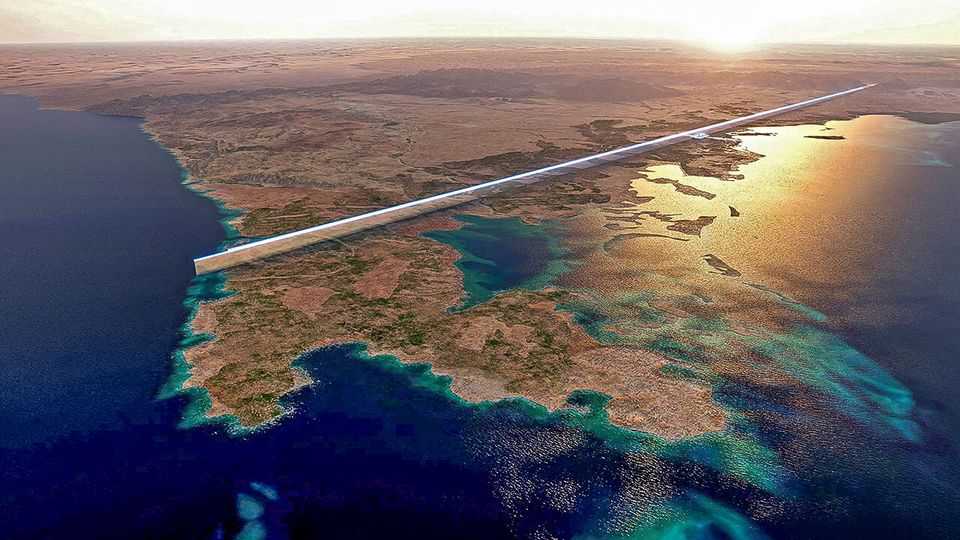
THE BILLBOARDS still line the motorway from the airport to the Saudi capital. They promise a “new modern downtown” for Riyadh, to be dominated by a cube-shaped skyscraper meant to be the world’s most voluminous building. Developers pressed ahead despite warnings that the cube, known as the Mukaab, would collapse under its own weight. The “giga-project” was a centrepiece of Vision 2030, the kingdom’s scheme, introduced in 2016, to diversify its oily economy.
With oil prices stubbornly low, however, Saudi Arabia can no longer afford such ventures. The laws of gravity won out, both physical and financial. Last month the kingdom halted work on the Mukaab. Construction has also largely stopped on The Line, a fanciful $500bn-plus “linear city” in the desert. The 2029 Asian Winter Games have recently been moved to Kazakhstan because a ski resort being built in Saudi Arabia’s mountainous north-west will not be ready on time.
Authorities now promise a tighter focus on a few sectors of the economy, in particular on tourism, manufacturing and logistics. That would be a welcome (and long overdue) shift away from science-fiction schemes that gobbled up enormous amounts of capital.
The giga-projects are not the only area where Vision 2030, now past its halfway point, has encountered headwinds. The scheme is meant to steer Saudis away from state sinecures and into the private sector, which often means pushing them towards low-wage jobs once filled by migrants. Muhammad bin Salman, the crown prince and the kingdom’s de facto ruler, is keen to see Riyadh grow. That has strained housing and services in the capital. He also wants to woo skilled expats in finance, tech and other sectors, putting his citizens in competition with foreigners. These contradictions amount to a rupture in the social contract.
People are particularly concerned about jobs and wages. At the beginning of Vision 2030 the average Saudi worker took home 10,045 rials ($2,679) in monthly pay. Nine years later the mean wage is 11,197 rials, a 11% increase. Cumulative inflation during those same years amounted to slightly more than 17%: salaries, in other words, have not kept pace with prices. Some families have compensated by adding an extra one. Among the goals of Vision 2030 is to boost female employment, and Saudi women have responded enthusiastically. In 2016 just 19% of the female labour force was employed; by 2025 that figure had climbed above 34%.
Women still earn less than their male counterparts, and the wage gap has grown, in part because women have piled into service jobs (selling lingerie and perfume in malls, for example, is now the exclusive preserve of female citizens). Still, the surge in women’s employment has topped up household incomes. A survey in 2018 found that the average Saudi family earned 14,823 rials a month, while in 2025 it was 18,056 rials.
If families are earning more, however, they are also paying more. The Gulf Co-operation Council (GCC), a club of six petro-monarchies, decided in 2015 to introduce a uniform 5% value-added tax. Saudi Arabia duly imposed one in 2018, then tripled it during the covid-19 pandemic—ostensibly a temporary measure to offset plunging revenue elsewhere, but one that was never reversed. Subsidies on electricity, fuel and water have been slashed. People are expected to work for longer as well. For young workers, the retirement age has increased from 58 to 65.
Higher prices are a particular strain on Saudis who moved to Riyadh in search of jobs. Before Vision 2030 Jeddah was the kingdom’s commercial capital, thanks to its role as a trade hub and the entry point for pilgrims to Mecca. The eastern province, Saudi Arabia’s oil patch, was vibrant too. Riyadh was a sleepy seat of government and a few national champions. No longer: the crown prince is pouring billions into the capital, investing in everything from parks and universities to a financial district and a world-class airport. For young Saudis looking for a job, Riyadh is the place to be.
The influx of both Saudis and expats has sent house prices soaring. Rents in the capital are up by more than 50% since 2020. Last year Prince Muhammad imposed a five-year freeze on rents in the capital, a nod to the growing strain on household budgets. Perhaps because of soaring costs, many Saudi families no longer rent: around two-thirds now own their homes (another goal of Vision 2030, which aims to boost the ownership rate to 70%). But buying in Riyadh is not cheap either. Prices of flats have doubled since 2020, to more than 6,000 rials per square metre, according to Knight Frank, a consultancy. Meanwhile, prices in Jeddah and the east have barely budged.
For decades the state was the largest employer of Saudis: a government job was seen as a birthright. Civil servants were not rich, and their salaries and benefits fluctuated along with the oil price. But they made a decent living. Apart from diplomats and oil-company workers, who lived in isolated compounds, the kingdom’s expats were mostly low-paid labourers from Africa and Asia. The social contract looks quite different today. Young people move to Riyadh for low-paid service jobs in the private sector, then watch as expats land cushy contracts.
Last January the kingdom opened its first alcohol shop, which catered exclusively to non-Muslim diplomats with a permit from the foreign ministry. In November it expanded access to expats with long-term residency or salaries above 50,000 rials a month. The unexpected move was a welcome sign of ongoing social liberalisation. It was also a reminder of the enormous wage gap between foreigners and locals: few of the latter dream of earning so much.
Young people are frustrated with precarious, tedious service jobs that pay too little for them to consider starting a family. The capital is booming yet unaffordable while second-tier cities feel stagnant. Income inequality is a growing problem for the kingdom’s rulers. Such complaints might be new to Saudi Arabia—but they are quite familiar to people elsewhere in the G20. It is a curious accomplishment for Vision 2030: in trying to diversify the Saudi economy, it has introduced the sorts of dilemmas that exist everywhere else in the rich world. ■
Sign up to the Middle East Dispatch, a weekly newsletter that keeps you in the loop on a fascinating, complex and consequential part of the world.