Asia | Thai politics
Thailand’s conservatives win a shock big victory
Prime Minister Anutin Charnvirakul has revived the Thai right’s electoral fortunes
February 12th 2026
Editor’s note: This article was updated on February 11th.
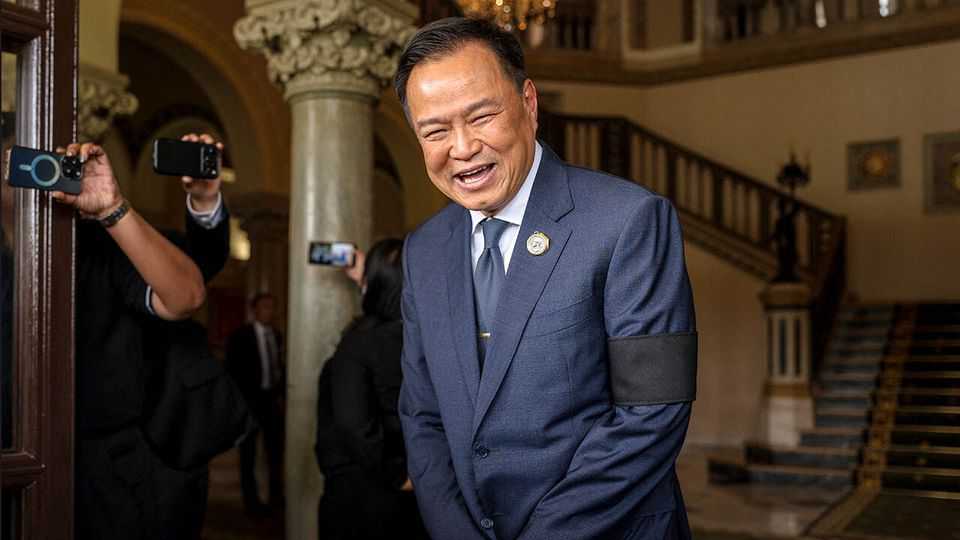
FOR THE first time this century, Thailand’s conservatives have won a general election outright. On February 8th voters awarded the Thai Pride Party (BJT) of Anutin Charnvirakul, the new prime minister, a surprise victory. The result could lead to an unusual run of political stability in a country that has mostly lacked it since the Asian financial crisis began in 1997. But it will delay, perhaps indefinitely, reforms to the monarchy and the armed forces championed by the liberal opposition. And it leaves core economic policy questions unanswered.
In recent years, Thai politics have been a three-cornered contest. Conservatives champion the role of the king and the armed forces in public life, with the support of the small number of tycoons who dominate the economy. Populists challenge that concentration of wealth through spendthrift redistribution proposals, while liberals argue for freer markets and for restricting the role of the monarchy and army.
In 2023 the liberal Move Forward Party surged to a first-place finish, planning to form a majority coalition with some of the populists in the lower house. But the senate, which had been appointed by the armed forces, blocked Move Forward from taking office. The party was later banned. Instead, Thailand has since then endured a series of fragile coalitions between populists and conservatives. Mr Anutin came to office at the head of a conservative minority government last year on a promise to call fresh elections.
Voters on February 8th ended years of deadlock by breaking decisively for the conservatives. Using unofficial results, Thai media project that Mr Anutin’s BJT will hold just under two-fifths of the seats in Parliament’s lower house. That means he should be able to cobble together a majority among other conservative parties without too much difficulty, and probably not need to rely on the populists.
How did Mr Anutin do it? The man himself is a factor. The easygoing heir to a construction fortune has far more charisma than the arrogant and inept generals who had otherwise fronted the main conservative parties since a coup in 2014. He has also shown a sharp instinct for what voters want. In rural areas, he has made good use of patronage politics by recruiting scores of local political bosses to run on his party’s ticket.
To their voters, he offers a sprinkling of fiscal policy handouts usually associated with Thailand’s populists. And for better-off voters eager for competent policymaking, he has appointed technocrats to run the commerce, finance and foreign ministries. Two short border wars with Cambodia last year led to a rise in nationalism, boosting his Thai Pride Party.
Thailand’s liberals, who in 2024 regrouped into the new People’s Party, are licking their wounds. At the party headquarters in Bangkok, the capital, the mood was one of sadness and confusion. Polls had shown them in first place throughout the campaign. But although they won more votes nationwide than any other party, these were too heavily concentrated in cities and among the middle-classes. That punished them under Thailand’s largely first-past-the-post system. Not only will they remain in opposition, but they will be in no position to shape the drafting of a new constitution that voters authorised in a simultaneous referendum on February 8th.
Voters will have to wait to see how that process will play out in the next parliamentary session, which only gets under way in April. They will wait, too, to see whether Mr Anutin’s economic policies will be moulded more by the professionals whom he has appointed to draw them up or by the populist politics of his most important supporters in the countryside. Thailand’s increasing budget deficits argue for old-fashioned fiscal prudence. But Mr Anutin did not bring Thailand’s conservative movement back to life by doing things the old-fashioned way.■