Britain | Growth’s dubious precision
Britain’s shifting GDP numbers
The economy is growing. But how strongly?
February 12th 2026
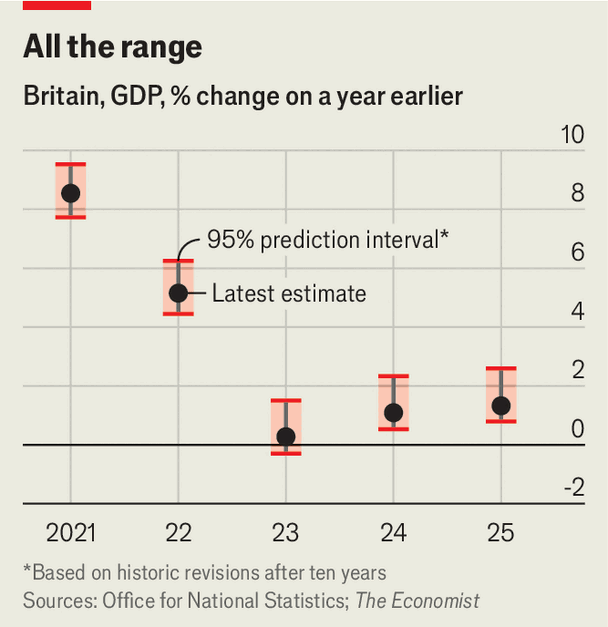
SIR KEIR Starmer’s central mission was to “kick-start” economic growth. So news from the Office for National Statistics (ONS) that the economy grew by 1.3% last year—the fastest since 2022 and the third-fastest in the G7—will be welcome for the prime minister (see chart). Still, the numbers are not yet set in stone.
Statisticians use three data sources—on output, income and expenditure—to measure GDP. They triangulate their best estimate of economic activity based on a reading from all three. The figures released on February 12th include the ONS’s “first estimate” of GDP for the final three months of 2025. It reckons the economy was 1.0% bigger in the fourth quarter of 2025 against the same period a year earlier (not to be confused with the number comparing full calendar years). But this figure leans on about four-fifths of available output data and far less income and expenditure data.
A second estimate, based on more complete data, will follow in seven weeks. Judging by recent revisions, that is likely to show a slight improvement on the initial number: about two-thirds of revisions are upwards. But revisions do not stop there. The ONS does not get a full picture until all tax records are submitted after three years; and periodic revisions continue as it incorporates new estimation methods. Sir Charlie Bean of the London School of Economics, who conducted a government review of GDP figures in 2016, says “You’re always running to catch up as a statistician.”
So rather than being fixed, estimates of economic growth evolve over time. According to analysis by The Economist of the ONS’s revisions since 1960, quarterly GDP growth stabilises only after about ten years. Revisions can be big: the first estimate for Q3 1988 suggested a 0.5% decline in GDP; three years later it was revised to 3.6% growth. The ONS’s revisions became smaller from the late 1980s but, according to our number-crunching, since 2012 they have increased by about half. Falling response rates to surveys compromise the quality of some of the source data. Even so, Britain’s revisions have historically been the smallest among 15 OECD peers.
The ONS also publishes a monthly GDP figure based on output data alone, which is released six weeks after the end of each month. Our analysis finds that December’s GDP reading of 0.1% compared with the previous month is likely to be revised to anywhere between -0.5% and 0.9% in 12 months’ time. Statisticians know that there is a trade-off between timeliness and accuracy, but reporters rarely treat the numbers with due caution.
Sir Charlie says that decision-makers—such as economists setting interest rates and investors buying government debt—will know to discount GDP data for its quality, but initial growth estimates materially affect political narratives. While Sir Keir’s government may soon start boasting that growth last year was the fastest for three years, the history of revisions suggests that in ten years’ time growth for 2025 could lie anywhere between 0.8% and 2.6%. ■
For more expert analysis of the biggest stories in Britain, sign up to Blighty, our weekly subscriber-only newsletter.