Europe | Charlemagne
The European Onion is a joke whose time has come
A new model of European integration, without the tears
February 12th 2026
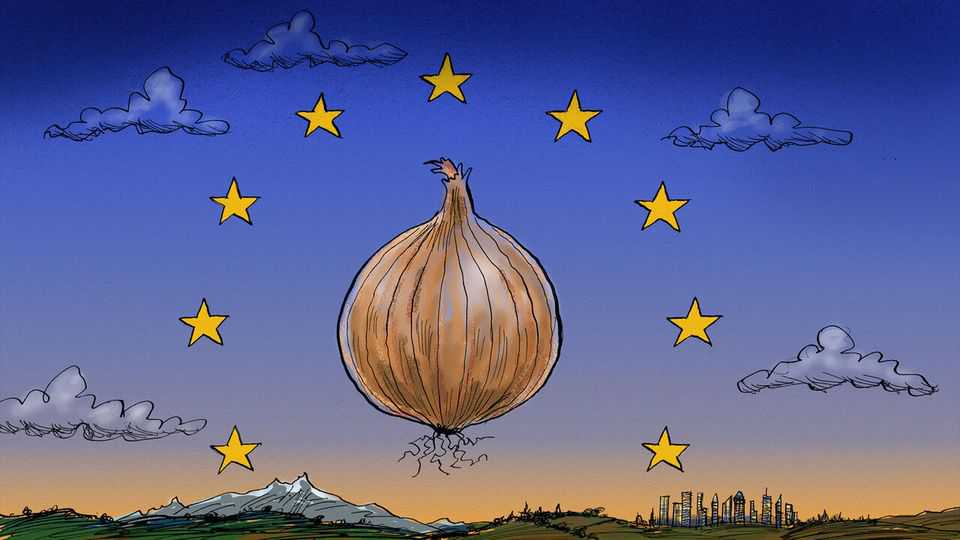
Over their eight decades of lurching towards ever-closer union, European federalists have marched under a succession of lofty banners. At first there was a “Council” of Europe, later several European “Communities” of various guises alongside a free-trade “Association”. In 1993 the European “Union” was born. To many the obvious next step could only be a United States of Europe. Not so. Instead, a new and unexpected mode of continental togetherness has now sprouted: the European Onion.
The idea that European integration should take this bulbous form started as a joke by Bart De Wever, a continental wit who moonlights as Belgian prime minister. Recently he quipped that for years he had misheard Charles Michel, a heavily accented compatriot who formerly chaired meetings of EU leaders, talk of ze Euh-ropean Euh-nion. The European…Onion? The confusion turned out to be fortuitous. “I think this is exactly what Europe needs to become,” Mr De Wever said, “an onion of multi-layers.”
It is not just Mr De Wever who thinks the eye-watering pantry staple—the base of recipes across the continent, from risotto to Swedish meatballs and Polish dumplings—offers a tasty way to get dozens of European countries to work together better. As things stand, the continent is generally governed by the EU’s one-size-fits-all model, which tends to move only as fast as its slowest member allows. A stratified approach, with some countries forming a federalising core while others stay in the looser outer layers, would help Europe keep up in a newly harsh geopolitical world. The European Onion is a joke worthy of serious times.
In part the EO approach has already taken root. “Coalitions of the willing” abound these days. A new “E6” of heavy hitters, made up of France, Germany, Italy, the Netherlands, Poland and Spain, is branding itself as a pioneering kernel of economic integration. For informal discussions of security matters there is the even more selective E3, comprising France, Germany and Britain—a country outside the EU. When, in December, a package of €90bn ($106bn) in assistance to Ukraine was blocked by a small minority of the EU’s 27 national governments, 24 of them decided to push ahead regardless, leaving Hungary, the Czech Republic and Slovakia aside. Accepting that some countries would stay on the onion’s outer layer prevented the whole scheme from ending in tears.
Groups of countries “forging ahead” are not entirely new in Europe. For one, the EU is not the only show in town. The NATO alliance encompasses most but not all EU members, and a few countries outside the club (notably Britain and America). Even within the EU proper, two big federalising milestones, the single currency and the Schengen passport-free area, include most but not all the members. But although more EU decisions have shifted to qualified-majority voting, where big countries count more and objecting ones can be forced to play along, the thorniest decisions usually require hashing things out until everyone agrees (or can live with it). The idea of a two-speed Europe—or of “variable geometry”, to use an ugly bit of Euro-jargon—has long been dismissed as a second-best option.
Purists still prefer it when Europe moves forward as one. For them, à la carte integration undermines the worth of the single market at the EU’s heart. Member states left out by the federalising core, notably in central Europe, sometimes grouse that they are treated as second-class. Multiple layers add complexity to a set-up that is already hard for many to grasp. (Who outside of a few buildings in Brussels knows the difference between the Council of Europe, the European Council and the Council of the European Union?) Transforming continental governance into a multi-dimensional Venn diagram of overlapping schemes risks turning the opaque into the impenetrable. That is why relatively little use has been made of an existing provision in the EU treaties allowing for “enhanced co-operation” (yet more ugly jargon) among some member states but not others. A simpler, one-speed Europe going slowly was preferred to a multi-speed one that risks division.
No longer. These days concerns around internal fragmentation have been trumped by the fear of inertia. Given the world’s unforgiving new realities, Europe must reform rapidly. It needs to tackle its sluggish economy and puny defence abilities, for starters. Because that requires greater co-operation, France, Germany and others cannot wait until every member state signs up to everything. (Hungary, under the cantankerous leadership of Viktor Orban, already wields too much veto power.) Even well-meaning EU members sometimes differ over how much sovereignty to pool. Mario Draghi, a former Italian prime minister, speaks of “pragmatic federalism”, with a core pushing further ahead to get things moving. Where some countries lead, others may follow (many holdouts on the euro have since joined, for example). But the reticent should not stand in the way of pioneers.
The European Onion approach could help even more when it comes to the continent’s crinkly outermost layers. A multi-tiered system would help the EU deal with those who are outside the union but need to work more closely with it. Ukraine, for example, is being promised EU membership as part of a peace deal to end its war. But it will be years before it can meet the exacting standards expected of full members. A sort of “outer-tier” membership would help. Britain might find it attractive, too.
With multiple cores sitting side by side, perhaps Europe will become not so much an onion as a garlic bulb, or even a grapefruit. Whatever the favoured metaphor, it is clear something needs to change. Further across-the-board federalism looks unfeasible. Building the continent layer by layer is the most sensible plan. Europe is in a pickle. Going the way of the onion will help. ■
Subscribers to The Economist can sign up to our Opinion newsletter, which brings together the best of our leaders, columns, guest essays and reader correspondence.