Middle East & Africa | An unlikely journey
Don’t welcome Africa’s newest despot
Samia Suluhu Hassan has caused Tanzania’s most dangerous crisis since independence
February 12th 2026
The party that has ruled Tanzania since independence from Britain in 1961 is a strange beast. Under Julius Nyerere, the country’s founding father, Chama Cha Mapinduzi (CCM), which translates as “party of the revolution”, forced millions onto collective farms. Yet faced with a wrecked economy and a population chafing under single-party rule, it changed course. After Nyerere stepped down in 1985, CCM oversaw Tanzania’s turn to flawed but competitive democracy. As recently as 2024 it was the country’s most popular party, according to Afrobarometer, a pollster. Its 65-year rule is the longest of any party in Africa.
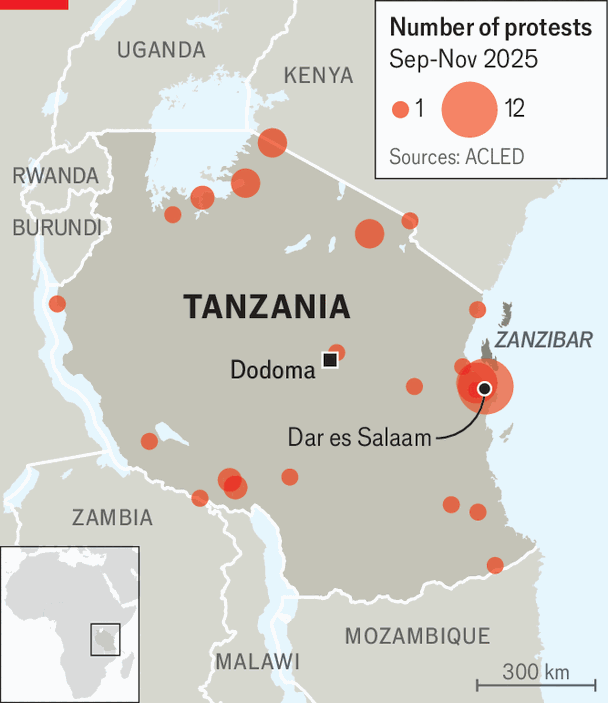
But for how much longer? Under Samia Suluhu Hassan, Tanzania’s president and the party’s chairperson, CCM is facing the most severe legitimacy crisis in its history. An election in October sparked the first-ever mass protests in the usually placid population of more than 70m (see map). Hundreds, possibly thousands, of people were killed by state security forces. As Tanzanians died in the streets, Mrs Samia claimed a ridiculous 98% of the vote. Dan Paget, a British academic specialising in the country, reckons the last time mainland Tanzania experienced such brutality was under German colonial rule more than a century ago.
The party, which is in effect synonymous with the Tanzanian state, finds itself at an inflection point. The EU has frozen aid. America, which worries that Christian churches are under threat and that American investors are being unfairly treated, is reviewing bilateral relations. The government’s lack of public sympathy for the victims, compounded by its alleged destruction of incriminating evidence, has “created a very angry nation”, says a prominent opposition figure.
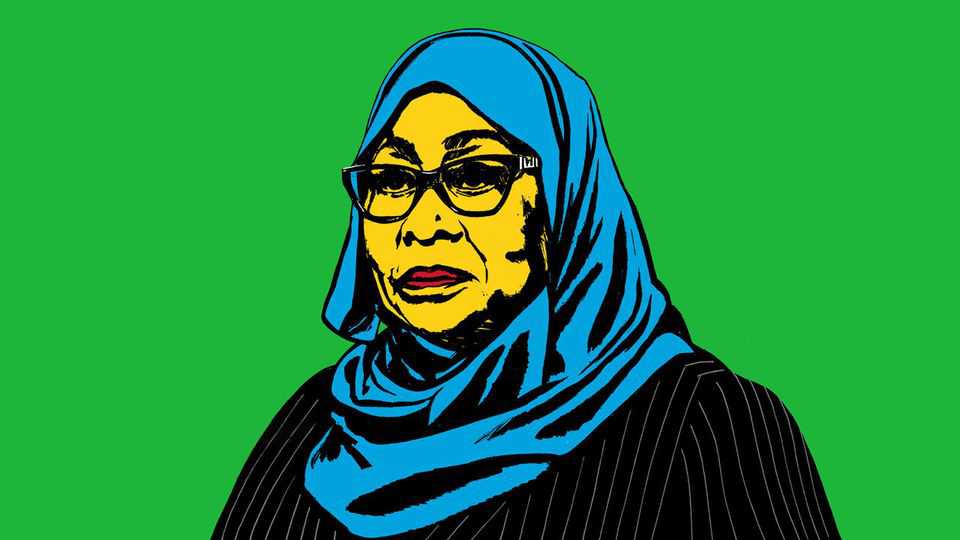
Mrs Samia, who took office after her autocratic predecessor, John Magufuli, died in 2021, was long seen as weak. A Muslim from the semi-autonomous archipelago of Zanzibar, whose population is about 3% of the national total, she has no base within the party and little charisma. She first styled herself as a liberal-minded reformer, welcoming opponents home from exile and mending ties with foreign investors. Many Tanzanians believed her.
Yet it was clear long before the violence in October that Mrs Samia was no moderate technocrat. A promised review of the constitution, which gives the president enormous power, quickly stalled. When opposition parties threatened to boycott the election, the government arrested Tundu Lissu, Mrs Samia’s most prominent opponent, and put him on trial for treason. (He remains behind bars.) Scores of critics, including a CCM bigwig and a Catholic priest, disappeared over the course of 2025. Many are feared dead.
It was once suggested that, hailing from a marginalised island, Mrs Samia had been forced to ally with hardliners in the party and the security services. But following repeated reshuffles, Mrs Samia is “increasingly in command of every arm of the regime”, notes Mr Paget. A Western diplomat in Dar es Salaam, the commercial capital, says she has shored up her position by surrounding herself with “Zanzibaris, her family and her neophytes”. She recently appointed her daughter as deputy minister of education and installed her son-in-law as minister of health.
Further repression is likely. But to stay in power for much longer, the CCM knows it needs to deliver material benefits. For the past two decades Tanzania has achieved annual GDP growth of 6% on average. But with the population growing at nearly 3% each year, some officials acknowledge that is not enough. Too few young people have formal jobs, so they are easily “triggered” into joining protests, says Kitila Mkumbo, the state minister for planning and investment.
Fixing this requires higher growth, such as China—a close CCM ally—managed in the years following the protests and massacre near Tiananmen Square in 1989. The government’s priority since October has been to “reassure the existing investors in the country that their investments will remain safe”, says Mr Mkumbo. Officials also appear keen to speed up negotiations over a long-delayed liquefied natural gas plant, on which a final investment decision is expected this year.
That may not be enough to see off dissent. Corruption is widely thought to have increased under Mrs Samia. “Everyone is rent-seeking,” says Aida Kiangi, a Tanzanian business and energy expert. Foreign firms complain of shake-downs. “Things are better for the corrupt oligarchs here,” says a Western diplomat. “Things are not better for foreign investors.”
Another problem is the president herself. Some of the criticism stems from misogyny and Islamophobia. But whereas Magufuli was widely seen as serving the interests of ordinary Tanzanians, Mrs Samia is often accused of serving the rich. In the past the CCM has responded to public discontent by reforming itself. Mrs Samia established a commission to investigate the violence around the election, which is due to report later this month. She has promised another commission to pursue national conciliation, and, yet again, a review of the constitution.
Change may come in other ways, such as a coup within the CCM. Some in the party worry about another uprising. A former minister recently warned that unless the security forces show “humanity…CCM will be removed from power.” Outsiders cannot know how widespread such feelings are. But the politics of a country known for stability are less predictable than they have been in decades. ■
Sign up to the Analysing Africa, a weekly newsletter that keeps you in the loop about the world’s youngest—and least understood—continent.