United States | Latin lessens
America may be reaching peak Spanish
Bad Bunny’s Super Bowl show may mark a ceiling for the language he performs in
February 12th 2026
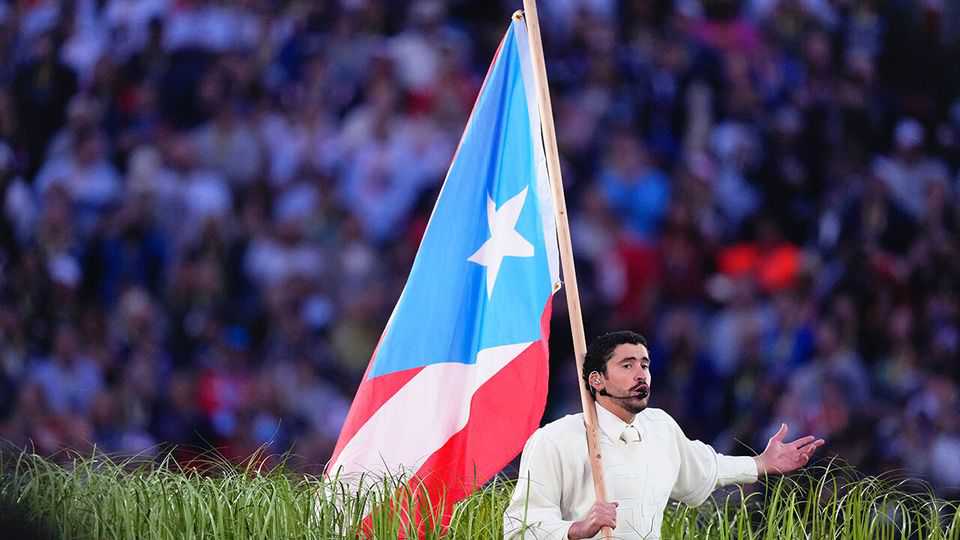
Not everyone enjoyed Bad Bunny’s Super Bowl halftime show. “Nobody understands a word this guy is saying,” complained President Donald Trump of the Puerto Rican singer’s Spanish lyrics. That is not strictly true. With more than 40m Spanish speakers, America is the fifth-biggest Hispanophone country in the world, not far short of Spain.
Babbel, which makes a language-teaching app, says that the share of its American users studying Spanish shot up from 26% to 60% between 2012 to 2025. The company notes that Spanish podcasts are gaining listeners, Spanish-speaking artists are winning more Oscar nominations and Spanish-speaking books are being checked out in growing numbers from libraries, among other indicators. Some English-speaking Americans worry that the rise of Spanish in their country is unstoppable.
That is unlikely. The number of Spanish-speakers in America will probably plateau, and eventually reverse, for two reasons. The obvious one is immigration policy. Under Mr Trump the flow of immigrants from Latin America has become a trickle. And ICE is deporting as many illegal (and sometimes legal) immigrants as it can. The crackdown will no doubt ease under a future Democratic administration, but America will probably not be as welcoming as it once was.
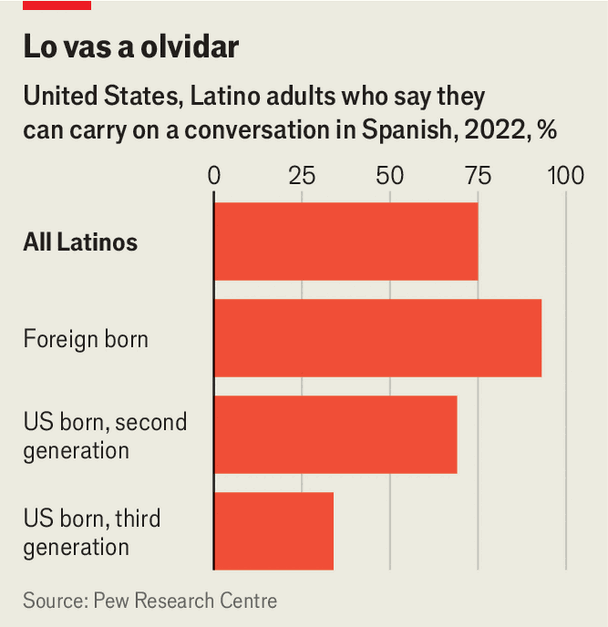
Another trend is less visible and as important. The longer Latino families stay in America, the less Spanish they speak. According to Pew, a pollster, 69% of second-generation Latino immigrants—that is, the first generation born in America—speak Spanish. That drops to 34% of the third generation. Pew does not survey later generations, but overall just 57% of American-born Latinos speak Spanish.
In contrast to many English-speakers, Spanish-speakers fret—with good cause—about the fate of their language in America. “No sabo kids” don’t speak Spanish or speak it badly. (No sabo is “Spanglish” for “I don’t know”. In proper Spanish it’s no sé.) A majority of non-Spanish-speaking Latinos admit that they have been shamed by other Latinos for not speaking it. But 87% of American-born Latinos say that it is not necessary to speak Spanish in order to be considered Latino.
America is changing Spanish as much as Spanish-speakers are changing America. Borrowings from English like “bildin” and “jaiscul” (“building” and “high school”) are common. Kim Potowski of the University of Illinois, Chicago, highlights how Spanish words are being used in English ways, as in “escribir un papel”, “to write a paper” (papel is not used for that kind of paper in Spanish). American Latinos borrow entire grammatical structures from English in sentences like “Es la chica que hablé con”—“that’s the girl I was talking with”—whereas conventional Spanish requires the equivalent of “that’s the girl with whom I was talking.”
America’s assimilation machine has, over the centuries, turned huge waves of Germans and Italians into monoglot Americans. For a while, thanks to bilingual schools and Spanish radio and television stations, it looked like Latinos might be the exception. They’re not. Mr Trump won nearly half of the Latino vote in 2024; 36% of Latinos support making English the official language. Spanish is under threat in America, not English. Bad Bunny’s Super Bowl set may signify not the rise of Spanish in America, but its peak. ■
Stay on top of American politics with The US in brief, our daily newsletter with fast analysis of the most important political news, and Checks and Balance, a weekly note that examines the state of American democracy and the issues that matter to voters.